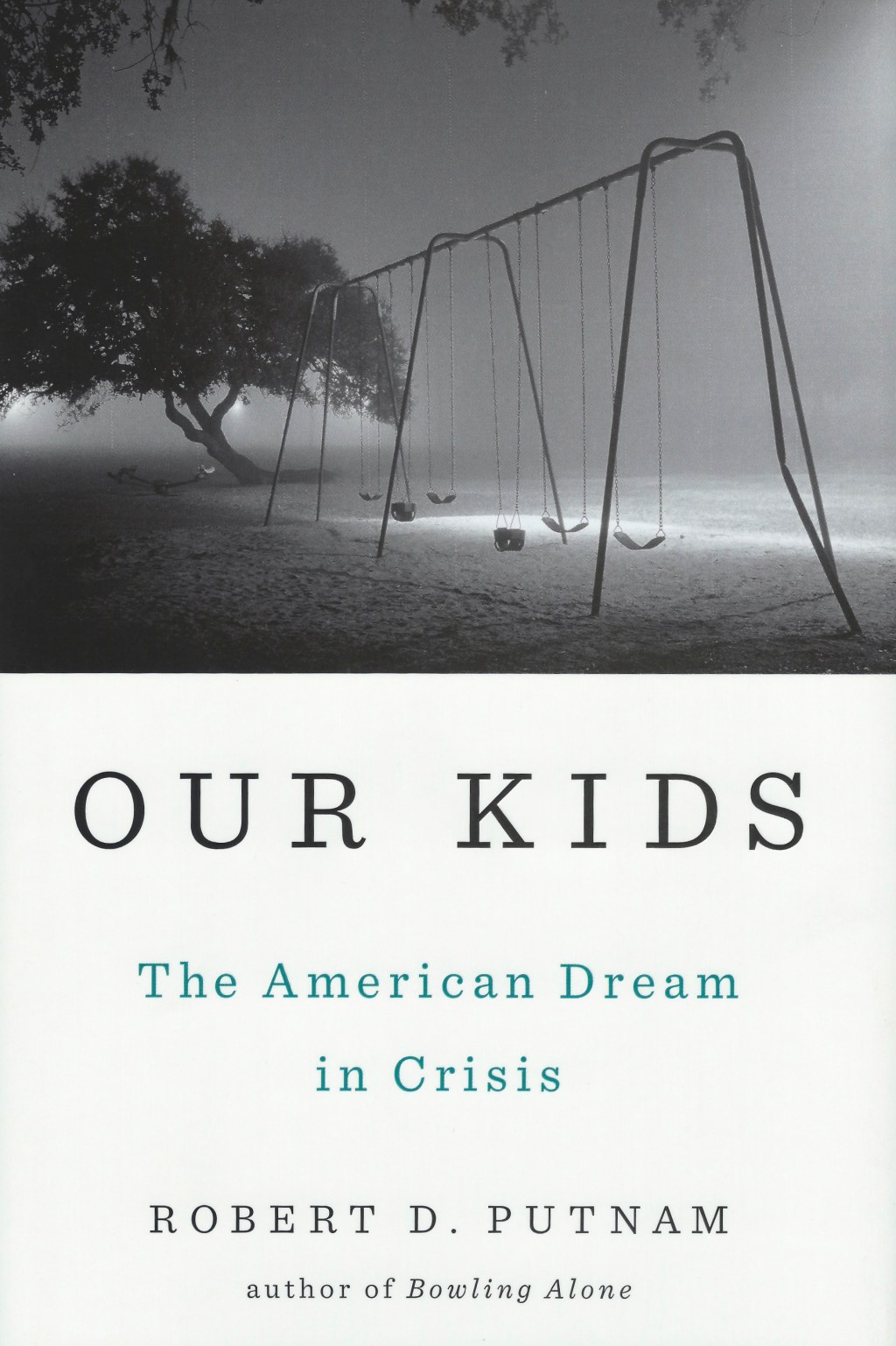
After I quit watching NBC Nightly News when Brian Williams was suspended, I turned to PBS NewsHour with Judy Woodruff and Gwen Ifill for a nightly source of news (I have no plans of returning to NBC Nightly News after watching their great segments on a regular basis). Back in March I watched the segment Making Sen$e by Paul Solman with Robert D. Putnam, the author of Our Kids: The American Dream in Crisis.
I ordered Robert Putnam’s book after watching the program because I was interested in the point made by Putnam and his 1959 classmates concerning the fact that whether rich or poor they were unaware of any wealth differences growing up and the statement “my hometown was, in the 1950s, a passable embodiment of the American Dream, a place that offered decent opportunity for all the kids in town, whatever the background.” A few decades later when I was growing up I would agree that statement still applied. After reading his book and watching how society has changed over the last couple decades, I agree that we have a changing trend in our society where the children growing up today will probably not have it better than their parents and that many of the premises of the book provide an interesting look at how our society has changed over the last three decades. According to Robert Putnam,
“This book adopts a different approach, eschewing the conventional “rearview mirror” method and examining directly what has been happening to kids in the past three decades – the families into which they’ve been born, the parenting and schooling they’ve received, the communities within which they’ve been raised. We know that those experiences will inevitably have a powerful effect on how well they do in life. Whatever changes we detect in these areas will foreshadow changes in social mobility – which distressingly, according to the evidence I describe in this book, seems poised to plunge in the years ahead, shattering the American Dream.”
The book offers an excellent sociological survey of the ways society has changed and the decreasing hope and possibility of upward mobility. The individual stories about children growing up provided a glimpse into some of the many different experiences and obstacles young people now encounter.
I don’t know if it is being middle-aged or a natural progression to aging, but life did seem simpler while I was growing up and if you were someone leaving high school without financial resources and a clue about the future, you still stood a very good chance of finding the answers and a very good living. If you did not have a career choice in mind, you could find an entry-level position, attend college in the evening after work and move up the ranks to a better paying position. Nowadays, when a college education is a definite factor in the level of your livelihood, some young adults head off to college with or without a plan, leave with a tremendous amount of student debt and are now taking entry-level positions that high school graduates hoped for in my day. For many, they are not leaving college and moving into mid-level positions, but are having to start at the bottom of the corporate ladder or are often unable to find jobs in their chosen field and are starting their future in debt.
The story of those with little or no education has become increasingly more difficult in our new global economy than it was several decades ago. With the loss of manufacturing and other better paying construction and laborer jobs, those less educated stand little chance of making the good wages that were once possible. According to a New York Times article, Why Less Educated Workers Are Losing Ground on Wages, “the median earnings of working men aged 30 to 45 without a high school diploma fell 20 percent from 1990 to 2013 when adjusted for inflation.” In addition, “men with a high school diploma did only a little better, with a 13 percent decline in median earnings over the same span.” There is little doubt how vital a college education has become in the ability to achieve the American Dream and while education was very important while I was growing up, there were still many other avenues available for achieving a decent living and possibly the American Dream. As a common middle ground in our society continues to disappear between the right and left in politics and the rich and poor, it appears, according to a point made by Robert Putnam in Our Kids: The American Dream in Crisis, that a common ground is also disappearing for our kids as “residential sorting by income over the last 30 to 40 years has shunted high-income and low-income students into separate schools.” As the gap between the “haves” and “have-nots” continues to increase socially and economically, I wonder in what year we will have our first graduating class of students that are unable to remember living in a society with livable wages, pensions and a strong middle class.

 CIMPLE - A Curious Introvert's Musings & Photos about Life and Enjoyment
Leave a comment